
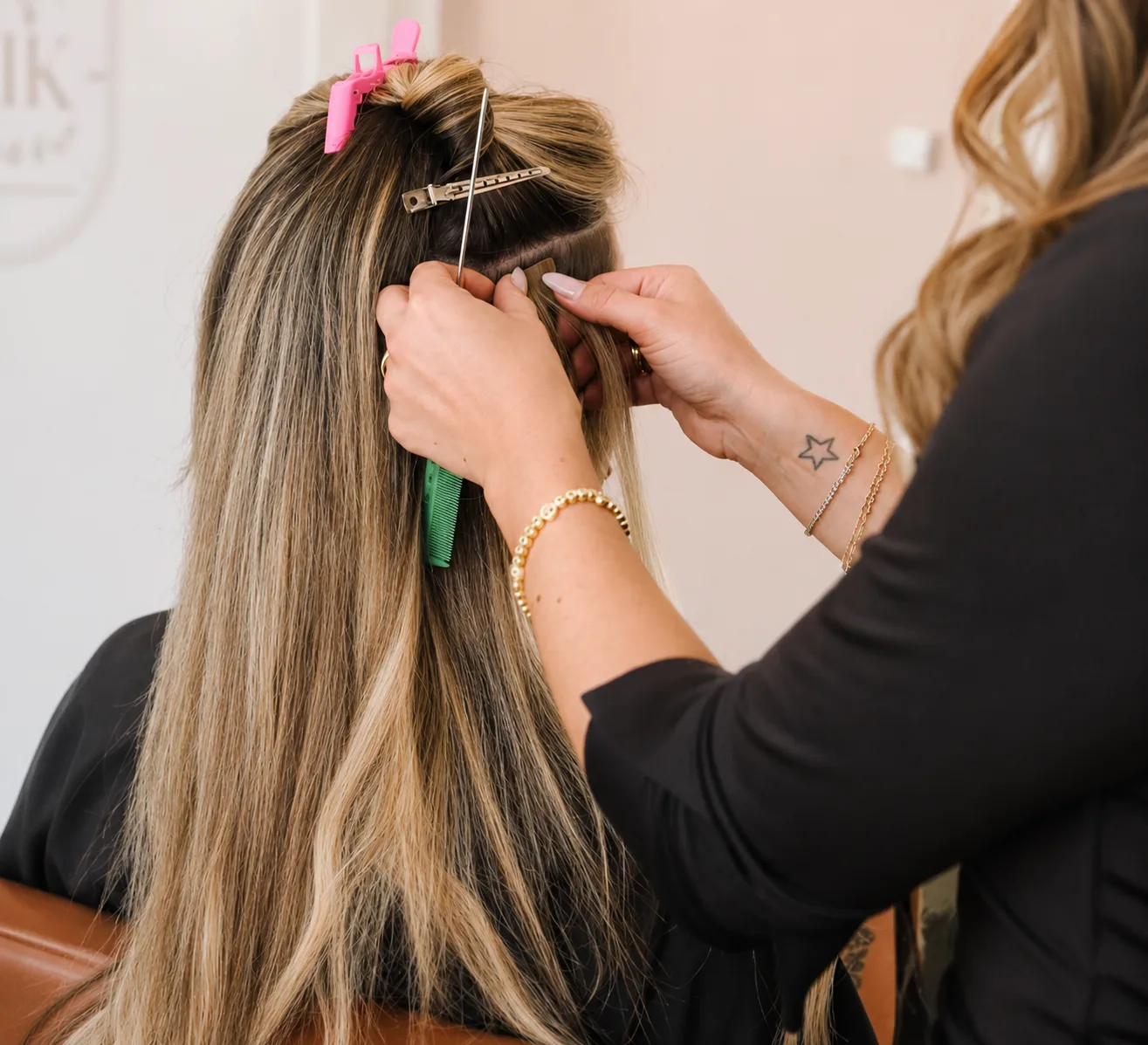
Tape-in extensions last on two separate clocks, and confusing the two is where most of the misunderstanding comes from. The tapes need to be moved up every 6 to 8 weeks as your hair grows. The hair itself lasts 6 to 12 months and can be reused through several move-ups. So the honest answer is: your appointments are every couple of months, but a good set of hair stays with you for the better part of a year.
I place tape-ins on clients in my Vancouver studio every week, and this is the question I answer more than almost any other. Below is exactly how the timeline works, what changes it, and the routine I give every client to get the most out of their investment.
What decides whether your extensions last three months or a full year is not the hair itself — it is whether you keep your move-up appointments.
The two timelines that actually matter
Timeline one — the move-up (every 6–8 weeks). Your natural hair grows roughly a centimetre or more each month. As it grows, the tapes travel down the strand and away from your scalp. Around the six-to-eight-week mark they have moved far enough that they need to be taken out, cleaned, re-taped, and repositioned back up near the root. This is normal maintenance, not a sign anything went wrong — it is simply the cost of the seamless, invisible look.
Timeline two — the life of the hair (6–12 months). The extension hair itself is reusable. As long as it is good-quality Remy human hair and you look after it, the same set gets re-taped at each move-up and worn again. Most of my clients replace their hair somewhere between six months and a year, depending on how hard they are on it. Lower-quality hair, or hair that has been neglected, gives up much sooner.
What determines how long they last
Two people can leave the same appointment and get very different lifespans out of their extensions. Here is what makes the difference.
The quality of the hair
This is the biggest single factor. Genuine Remy human hair keeps its cuticle intact and aligned, so it stays smooth, takes heat, and lasts. Cheaper hair tends to tangle and dry out within weeks. It is worth paying for the hair once and reusing it, rather than replacing a bargain set every couple of months.
Your home care
The tapes are held by adhesive, and oil is the enemy of adhesive. Heavy oils, silicones, and conditioner worked up into the bonds will loosen them and cause slipping. Sulphate-free, oil-free products used from the mid-lengths down keep the bonds secure and the hair healthy. How you brush and sleep matters just as much — more on that below.
Your lifestyle
Daily workouts, swimming, hot yoga, and frequent hot-tool styling all shorten the lifespan. None of them rule you out for tape-ins — they just mean we choose your placement and your at-home routine accordingly. This is exactly the kind of thing I want to know at your consultation, because it changes what I recommend.
The install itself
This is the part that is entirely on your stylist. Weight balance, placement away from the hairline, the right amount of hair for your density — get these wrong and even the best hair will not last or will stress your natural hair. This is the real argument for seeing a specialist rather than adding extensions as an afterthought.
The Vancouver factor
A detail most guides skip: where you live changes how your extensions wear. Vancouver's water is on the harder side, and mineral buildup from hard water dulls extension hair faster than it dulls your own — it has no scalp oils feeding it, so it cannot recover the same way. Over a few weeks that shows up as dryness and a slightly gummy feel at the bonds.
Our climate adds to it: dry, heated air all winter, then real humidity through the summer. The fix is simple. I have Vancouver clients do a gentle clarifying wash every few weeks to lift mineral buildup, keep a hydrating mask in rotation for the mid-lengths and ends, and — if it is in the budget — use a shower filter. It makes a genuine difference to how long a set stays glossy.
How to make your tape-ins last as long as possible
This is the routine I send every client home with:
- Wait 48 hours before the first wash so the adhesive fully sets.
- Wash 2–3 times a week, not daily, with sulphate-free, oil-free products.
- Keep conditioner and masks to the mid-lengths and ends — never up on the tapes.
- Brush twice a day from the ends up, holding your roots, with a proper extension brush.
- Keep hot tools under 300°F anywhere near the bonds.
- Tie hair back for workouts, swimming, and sleep, and use a silk pillowcase.
- Never remove them yourself — always come in for professional removal.
- Never skip your move-up. This is the single most important one.
The clients who get a year out of their hair are not doing anything extreme. They are just consistent, and they never leave their tapes in too long.
When it is time for a move-up
You will usually feel it before you see it: the tapes sit lower, you can feel them when you run your fingers through the roots, and a little tangling starts where the bond has grown out. That is your cue to book, not a reason to worry. Left past that point is when matting sets in — which is uncomfortable to remove and the one scenario that can genuinely stress your natural hair.
If you are weighing tape-ins against a bonded method, it is worth reading K-tip vs tape-in: which is right for your hair? next — the maintenance rhythms are quite different. And if you are ready to talk specifics, the best next step is always a consultation, where I can look at your hair and give you a real timeline for your density and lifestyle.
Frequently asked
How often do tape-in extensions need to be moved up?
Every 6 to 8 weeks for most people. Your natural hair grows about 1 to 1.5 cm a month, so after six to eight weeks the tapes have travelled far enough down the strand that they need to be removed and repositioned closer to the scalp. Leaving them longer is the most common cause of matting and damage.
Can you reuse the same tape-in hair?
Yes — that is one of the best things about tape-ins. With good-quality Remy human hair and proper care, the same set can be re-taped and reworn for roughly 6 to 12 months before the hair itself needs replacing. At each move-up the old tape is removed, the hair is re-taped, and it goes back in.
Do tape-in extensions damage your natural hair?
Not when they are placed and cared for correctly. Tape-ins lie flat and spread their weight across a wide section, so they are one of the gentler methods for fine hair. Damage almost always comes from wearing them too long between move-ups, at-home removal, or too much weight placed in one spot — all avoidable.
How long does a tape-in install take?
A first full install usually runs 1.5 to 2.5 hours, including the consultation, colour match, placement, and a cut to blend everything. Move-up appointments are quicker.
How do I make my tape-in extensions last longer?
Keep oils and heavy conditioners off the tapes, use sulphate-free products, brush gently from the ends up, keep heat tools under 300°F near the bonds, tie hair back for workouts and sleep, and never skip your move-up appointment. In Vancouver I also recommend a clarifying wash now and then to fight hard-water mineral buildup.
Ready to talk through your hair?
Book a consultation